
Menlo Park Kids Triathlon
When is Menlo Park Kids Triathlon?
Menlo Park Kids Triathlon takes place on Sunday, June 7, 2026 in Menlo Park, CA.
What distances does Menlo Park Kids Triathlon offer?
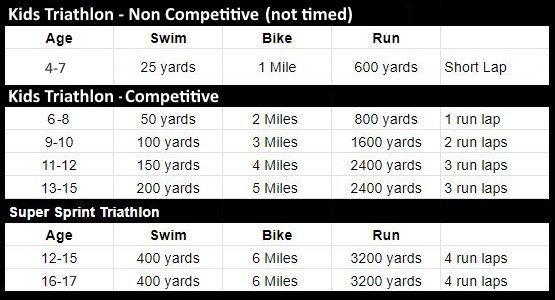
Menlo Park Kids Triathlon offers 3 events: Non-Competitve Kids Triathlon, Competitve Kids Triathlon, Super Sprint Triathlon.
| Event | Distance | Price | |
|---|---|---|---|
| Non-Competitve Kids Triathlon | — | $135.00 | Register |
| Competitve Kids Triathlon | — | $135.00 | Register |
| Super Sprint Triathlon | — | $135.00 | Register |
How much does Menlo Park Kids Triathlon cost?
Registration for Menlo Park Kids Triathlon starts at $125.00. Prices vary by event distance.
Where is Menlo Park Kids Triathlon held?
Menlo Park Kids Triathlon is held in Menlo Park, CA at Burgess Pool and Park Area.
About Menlo Park Kids Triathlon
The Menlo Park Kids Triathlon (“MPKT”) is a triathlon specifically for kids ages from 4 to 17 years old. A triathlon is a race that consists of a combination of three sports: swimming, cycling, and running. The kids start the race with swimming at the Burgess Pool in waves (triathlon speak for groups) of 20 to 25 kids. From the swim, they run to the transition area to put on their helmets, shoes, and anything else they need. They then mount their bikes and head out to the bike course. When the kids are done with the bike, they head back to transition to put their bike away, and head to run round Burgess Park. They finish the race in the park by crossing through the finishing chute!
2025 Race Photos

- Bike
After the swim, the athlete will ride his/her bike around the course. The number of loops is determined by age. ALL ATHLETES MUST wear their helmet the entire time they are on the bike. Please also make sure shoe laces are not undone or loose. Also, no aero bars on bikes.
Be sure to go out the “Bike Out” funnel to start the bike leg. Be sure to enter the “Bike In” funnel when you are finished with your bike leg.
Please slow down at all Turns and U-Turns, particularly the U-Turn near transition. Listen to all volunteers, they are there to help.

- Run
The “Run Out” is at the back of Transition. Run along the side of Transition, stay to the right on the sidewalk avoiding the Bike Course. Take a sharp right to begin your first lap. Be sure to cross the timing mat. One lap is 0.5 Miles.
At the end of your final lap enter the chute on your left to finish under the arch.
YOU MUST RETURN THE TIMING CHIP AT THE FINISH LINE

Non Competitive (4-7 year olds) Short Run

- Swim
*DO NOT CROSS THE TIMING PADS UNLESS YOU ARE IN THE MIDDLE OF RACING*
Drop Off Process
- Drop your athlete at the pool area approximately 20 min before their wave starts.
- Do this AFTER Registration
- Do this AFTER setting up Transition
- Once your athlete is in the swim area, if they are swimming, go around to THE OTHER SIDE OF THE POOL to watch them race
- We will be staging athletes up to three waves in advance of their start times
No parents are allowed on the pool deck except as permitted by the Swim Captain. This is for the safety of the participants. For the non competitve athletes 7 & Under, ONE parent will be permitted to accompany their athlete; no others will have pool deck access. No parents will be in the pool!
It is under the discretion of the Lifeguards and Swim Volunteers to pull your child from the pool if they do not think it is safe. NO CHILD WILL BE FORCED TO SWIM. They will be allowed to continue the triathlon once everyone in their wave has exited the water. Any child that is pulled from the swim is NOT eligible for awards but will still receive a medal.
If a swim aid is used, you must bring it. We will not provide swim aids. The only permitted swim aids are a personal flotation device (swim vest) or a kick board; be sure your child can swim if he/she loses grip on the kick board.
IMPORTANT SWIM INFO
- Athlete should wear snug fitting swim suit only (no cotton or loose fitting shirts)
- Cotton gets wet and is heavy and a swim hazard in the water
- Snug fitting rash guards are ok as long as the athlete has experience swimming with them beforehand
- Athlete should be prepared to swim with their own goggles or swim cap if they use them
- Don’t leave shoes on deck
- Pool area is not shaded, be sure to apply sunscreen before dropping off athlete
- Make sure athlete is well hydrated
- Make use of the porta-potties BEFORE entering the pool area
- Two athletes to a lane; Any swim stroke is allowed; flip turns are allowed
- Lifeguards and/or volunteers will be assigned to monitor the lanes
Non-Swimmers
We encourage all athletes to participate and have FUN, however on occasion some become apprehensive with the swim and change their mind about doing it at the last minute. This is OK, NO ONE has to get in the water for any reason if they don’t want to swim. ANY Parent/guardian trying to force an unwilling athlete to swim will be immediately removed.
Anyone not wanting to swim will simply be held on the swim deck until the last person in their wave has exited the water. The non-swimmer will then be allowed to continue the event by moving from the swim deck to the transition area. (Their race number will be noted and they will not be eligible for
awards)

- Transition
In the sport of triathlon, the Transition Area is like home base for the swim, bike, and run. The athlete passes through the Transition Area twice during the event: Swim to Bike and Bike to Run.
Every athlete has a spot in the Transition Area (not assigned) where their bike, helmet, shoes/socks, shirt, shorts, towel, and other essentials are located. The transition area is set up BEFORE the race starts.
The triathlon race itself begins at the pool. Following the swim, the athlete moves to the Transition Area where they remove any swim equipment such as goggles, quickly dries off, puts on their helmet and shirt, and walks the bike to the Transition Area exit following the sign that says “Bike Out”.
Bathing suit removal is not permitted. Athletes put on shorts and a shirt over their bathing suit with their race number pinned on in advance. Some athletes prefer to just put on a shirt (with number) and ride with bathing suits instead of shorts-over-suits.
After the bike ride the athlete returns to the Transition Area and walks the bike back to where their equipment is located. The bike is placed in the rack, helmet, and other riding equipment are removed, and the athlete prepares to run. Generally, young athletes ride their bikes in their running shoes so
after removing the bike equipment they are ready for the run. Runners may jog to the “Run Out” sign in the Transition Area, watching for bikes and other runners.

2025 Athlete Guide
Age Group Start Times
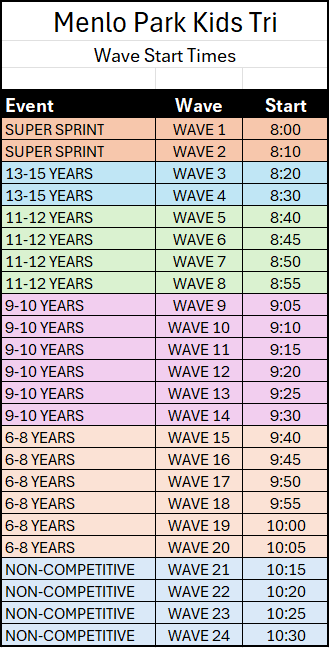
We will be starting the triathlon at 8:00 AM. We will proceed by age groups beginning with the Super Sprint, then the oldest competitve (13-15) and to the youngest competitve (6-8), and finally the non-competitve youth (4-7)
There will be many waves in each age group but your athlete must be at the event 60-90 minutes before their wavestart time to allow time to pick up thier packet, set up their transition area and be ready to start.
Start Times are preprogramed in the timing system. Your child MUST start on time in the correct wave. Early starts are disqualified.
2025 Age Group Wave Start Times

Click below for a complete list of participants and srart times.
*note: Per Federal Law we do not publish the first name of youth 13 and under.
Bike Checks
Pre-Race Mandatory Bike and Helmet Check
Your child’s bike and helmet must be checked before they race.
Bike Check dates for 2025:
5/17-5/31 - for the Menlo Park Kids Tri on June 1st
6/28-7/12 - for the East Bay Kids Tri on July 13th
8/2-8/16 - for the Silicon Valley Kids Tri on August 17th
Please bring your child with their bike and helmet to one of the participating stores listed below for a mandatory bike and helmet check. You will not be able to get your race packet unless you have the proper stickers proving your bike and helmet have been checked.
- At the Pre-Race Bike Check, your child’s bike and helmet will be inspected for:
- General condition with an emphasis on tires and free movement of the chain ring system
- The ends of the handlebars have plastic plugs (called bar-end plugs)
- Bike helmets are approved by CPSC or SNELL (label inside)
- Helmets must fit properly and the straps adjusted so no more than two fingers can fit inside
- There are no overly sharp edges on the pedals that could cut a leg in a fall
- The brakes work
- No aero-bars (if you don’t know what that is, the bike doesn’t have them)
If the bike is much too small or much too large for your child, it is up to the bike check technician to determine if this is a safety hazard. A small child on a bike who can’t touch the ground while seated is unsafe.
USA Triathlon rules specify that all bikes must have two wheels and each wheel must have a brake. Also, motors are not allowed. Disc brakes are fine as are electronic shifters. This means:
NO FIXIES • NO UNICYCLES • NO RECUMBENTS • NO E-BIKES • NO SCOOTERS
EXCEPTIONS: Children 6 and under may ride a balance bike or a tricycle and anyone may have training wheels on their bike.
We strongly recommend taking the bike to the pre-race inspection BEFORE the race (see above information). If the bike is deemed unsafe at the race your child will not be allowed to participate.
Attending one of the Pre-Race Bike Checks will help speed up the packet pickup process on the morning of the race. The bike technician will give you stickers that show you have passed the pre-check safety inspection.
You MUST get the stickers from one of the Bike Check locations in order to bypass the “Bike and Helmet Check” station on Race Day. The line in the morning could be an HOUR LONG in addition to the registration line. It is highly recommended to go to the Pre- Race locations!
NOTE: Please make sure your child’s footwear is suitable for running and riding. No flip-flops or sandals or other open-toed shoes. We recommend shoes with no laces or you purchase lace lockers as most falls in the race are caused by loose shoe laces.
Bike Check Locations
Call in advance to verify they have bike check stickers. Some bike technicians have reportedly not known they had them.
Check out our Charity Partner, Live in Peace, while getting your bike checked.
Hours: Tuesday through Friday, 12:00 pm to 5:00 pm (CLOSED MONDAYS)
All Sports Basements
Enjoy 20% off shopping the day of your bike check!
Check In
You will have to check-in for the Kids Triathlon on race day and pick up your race packet, and giveaways. Check-in will be held on the morning of the event beginning at 6:45 am. Signs will direct you to the Check-In Table.
You will be checked in by scanning your QR code or by name lookup. The QR code is in your confirmation email.
Your athlete must be at the event 60-90 minutes before their wave start time to allow time to set up their transition area and be ready to swim. If you need to go to race day “Bike and Helmet Check” then you need to come earlier.
There is no registration on Race Day.
Course Maps


Lap Counting
Please be sure your young athlete knows how many bike/run laps they needs to do. Volunteers will attempt to help count laps of competitive athletes from 6 through 17 using bracelets on the wrist and bib colors. However, it is the responsibility of each athlete to count their laps and get the bracelets.
Maps and Directions
Parking
There is parking next to the Gymnasium off of Alma ST, and behind the Swim and Sport Center, and on the opposite side of Laurel St.

Placing Race Numbers
You will have three numbered articles in your Race Packet: a large colored race bib and two smaller black and white adhesive tags. The colored bib is to be attached to a race belt or pinned on the front of a t-shirt or running shorts (safety pins are available at check-in). The color denotes your child’s age group. Chip timing will be used again this year. Instructions will be sent via e-mail prior to the race. Check the information on the bib to be sure it is correct. If there is an error go to the “Registration” table for a correction.
The small black and white tags are for the helmet and bike. Check to be sure that the two numbers match the number on the race bib. Put one tag on the front of the helmet. Put the other tag on the cross bar or handle bar of the bike.
The bib must be worn on the bike and run course. The color of this bib is how volunteers help your child count their laps! The bib should not be worn in the pool as it is not made to get wet.
The helmet sticker is used to sort your child’s photo so you can find them. This bike tag is used to identify your child’s bike when they remove it from the Transition Area after the race is over. A volunteer will match the bike tag to your child’s bib number.
(Note to past race participants: Please remove any old helmet stickers and/or race number tags from past or previous races. There will be volunteers in the Transition Area to assist with proper Race Number placement.)
Preparing Your Transition Area
Get to the race early enough that your athlete's transition area is set up in time. (1.5 hours before their wave is recommended.)
Look for signs designating the age-group of your athlete. Locations are not reserved and there will be enough for all athletes.
The race starts with the oldest and progresses to the youngest so there will be racers in the Transition Area when you are setting up. Please be courteous to them and stay clear.
For children aged 7-10, only one adult will be permitted with the athlete for setup and removal. A wristband is required. This is for the safety of the athletes.
After setup, please leave the area immediately. Only the athlete will be permitted in the transition area during the race, except for 6 & Under when one adult may accompany the child.
Bring two towels, one of which should be old. Put the old towel on the ground beside the bike at your child’s location and place their race equipment on it. The other towel is for drying off after the swim. A colorful, easy to recognize towel is recommended.
The time spent in the Transition Area counts in the overall time so it should be as fast as is reasonable but not so fast that your athlete forgets to put on the helmet or tie their shoes. We will have volunteers in the Transition Area to assist athletes so we REQUIRE that all adults stay out for the safety of all of the participants. An exception to this is for the 6 & Under age-group where ONE adult may assist the athlete if needed.
The Transition Area will be guarded by volunteers. To remove a bike from the Transition Area you must show a race number and match it to the race number on the bike. Your race packet will have a numbered race bib to be worn on the shirt or shorts and two small stick-on race numbers, one for the bike and one for the helmet. In addition each athlete will have their race number marked on their body by volunteers using pen. All of these numbers must match.
Race Day
What to Expect on Race Day
* Reading and following these instructions will help assure that race day will be a safe and enjoyable day for kids and adults alike.
Bring your child to the event NO LESS than one 1.5 hours before their age-group wave start time. One hour should give you time to pick up your packet, t-shirt, and goodie bag, get body marked, set up your transition area, and get ready for your swim wave.
Please allocate extra time if you have not attended a pre-race bike and helmet check. If you are late and miss your assigned wave, we cannot guarantee your child will be able to participate.
Please be sure to review our RACE RULES before the day of the race.
Race Day Schedule
Updated 2025 Schedule
-
6:45am - Race Day Packet Pickup opens
-
7:00am - Transition opens
-
8:00am - First Wave Begins
Race Rules
Wave Starts
The parent/guardian is responsible for getting their athlete(s) to the event with sufficient time to be ready for their swim wave. Waves are started and timed by pre-assigned numbers. Missing the start time will mean missing the event. The organizers will try to accommodate any unusual circumstances but there is no guarantee that it can be done.
PLEASE ARRIVE AT THE POOL AT LEAST 20 MINUTES BEFORE YOUR WAVE STARTS
Swimming
All athletes should be comfortable in the water. Each athlete should be capable of safely swimming the designated distance with no or minimal assistance.
Swim Aids
Swim aids such as kick-boards or approved flotation devices will be allowed. Pool “noodles” or other unapproved devices are not allowed. Water wings (aka Floaties) are ONLY allowed if they are the kind that are approved by the Coast Guard as a life-saving device – some are and some aren’t so check before you arrive and make sure your child’s ‘floaties’ are Coast Guard-approved.
Athletes using swim aids will not be eligible for podium awards (i.e., 1st, 2nd, 3rd place in age group). All athletes will get a participation medal. Athletes must provide their own swim aids. No performance enhancing devices such as fins will be allowed.
Cycling
Bike Helmets
Bike helmets must be worn AND STRAPPED from the moment the bike is removed from its rack until it is put back in the rack.
Helmets must comply with either CPSC, SNELL or ANSI standards as indicated by a label on the inside. Parents/guardians must assure that the helmet fit is proper for the athlete.
Bike Checks
Parents/Guardians are encouraged to take the athlete’s bike to a qualified shop for inspection and adjustment prior to the Kids Triathlon. The bike inspection at the event is only for basic functioning of brakes and steering, and is not a substitute for inspection by a qualified mechanic.
Attention should be paid to brakes, steering, wheels, inflation pressure, tire condition, chain, and pedals.
The openings at the ends of the handle bars must be securely plugged. “Bar Ends” (plastic caps) can be purchased at any bike shop. This is a safety item in the event of a fall. Bikes with unplugged handle bar ends will not be allowed. All bikes will be inspected.
The bike should be an appropriate size for the athlete.
Training Wheels and other Learner Bikes
Balance Bikes and Tricycles are allowed for children 6 and under. Training wheels are allowed for any age. All other bikes must have at least one brake.
(NO UNICYCLES, NO FIXIES, NO RECUMBENTS, NO E-BIKES, NO SCOOTERS)
Running
Parents/guardians should assure that the athlete has footwear that is suitable for running the designated distance. To avoid tripping, the athlete should be able to properly tie their shoes, preferable using double knots, or by using lock laces.
Transition Areas
The rules depend on the age of the child. Volunteers will be present to assist all athletes and to restrict access based on the guidelines listed below. Permission to enter to assist an athlete must be granted by the entrance monitor. This restriction is to ensure a safe and enjoyable experience for all of the athletes.
Non-Competitive Ages 7 & Under
One adult may be with children this age for the entire race. This includes being in the transition area during a transition. The adult will have a wrist band to show that they can do this.
Competitive Ages 6-10
One adult may accompany the child into transition to help set up their area. They are not allowed in again except when the child is done racing and it is time to tear down their spot and go home. They adult will have a special wrist band to show they are allowed to do this
Ages 11 & Up
No parents or guardians are permitted in the Transition Area for these ages.
Athlete Health & Safety
Athlete Health
Parents/guardians should assure that the athlete is in a physical condition that will permit him/her to participate in the event without jeopardizing his/her health or that of other participants. DO NOT PARTICIPATE IF YOUR CHILD HAS ANY SYMPTOMS OF ILLNESS even if you are sure it isn’t Covid.
Sun Protection
Due to multiple wave times, most athletes will have to wait before starting their race. Similarly, after the finish, athletes may choose to wait for the results to be posted. Parents/guardians should provide appropriate sun protection in the form of sunscreen and clothing. The event will attempt to provide some shelter but participants should not count on it, as resources are limited.
Hydration
The weather can be hot and it is vital that your child consume water to prevent dehydration. There will be water available before, on the course, and following the event. It is suggested that you place a full water bottle in your child’s transition area and remind him/her to drink during transition. They also should be reminded to drink at the various aid stations and following the event. Any child showing signs of dehydration should be brought to the Medical Tent.
First Aid
The event will have a medical staff available in the event of an emergency. Parents/guardians should familiarize themselves with the location of the First Aid tent (see course map). It is located in the area outside the pool exit and next to the Transition Area entrance. Lifeguards will be in the pool area and and additional medical personnel will be on the bike course. Event volunteers will be familiar with the location of the First Aid facility.
Penalties & Disqualification
Time Penalties
The following infractions will result in time penalties.
Not completing the required distance:
Swim: 5 minutes per lap
Bike: 15 minute per lap
Run: 5 minutes per lap
Throwing down the bike in some random location in transition:
Failure to return the bike to its original spot in transition will result in a time penalty of 2 minutes
Disqualifications
Unsportsmanlike conduct is grounds for disqualification. This includes, but is not limited to, interfering with other athletes, receiving outside assistance, and yelling at volunteers.
Volunteers will be monitoring the course and Transition Area for infractions. Disqualified athletes will receive a participation medal but will be ineligible for podium awards (i.e., 1st, 2nd, 3rd place in age group) and will not have their times posted.
Miscellaneous
Eyewear
Children that require prescription glasses should have a headband to hold the glasses in place during the event. If the glasses must be removed for the swim there will be a volunteer available to hold the glasses. Athletes who can see well enough to get around the pool and back to transition should consider leaving their eyewear in transition.
Age Limits
The upper age limit is 17 years old as of December 31st of the current year. The lower age limit is 4. However, parents/guardians should assess the child’s abilities to complete the prescribed course. The Kids Triathlon is conducted to be a positive experience and no child should be entered that is not going to benefit from the experience. Being asked to perform beyond one’s abilities may not be a positive experience.
Physically Challenged Athletes
The parent/guardian of a physically challenged athlete should contact the event organizers to make arrangement for any special needs. (Please do this two months before the race so we have enough time.)
Relays
There are no relay teams. Only one athlete is permitted per race number.
Weather Considerations
The race will be conducted rain or shine. Really.
Personal Music Devices
Earphones/Earbuds or any Music Device are not allowed to be worn during the race. Cochlear implants are allowed.
Non-finishers
Athletes not finishing the event will still receive a participant’s medal. Non-finishers will have no posted times.
USAT Rules
More USAT rules are HERE. Not all of them apply to Youth events. If a rule is different there, the rules here supersede the ones on the USAT website.
Sierra Cascades gives back
Sierra Cascades gives back to local charities, groups, and clubs who provide volunteers.
Volunteers who register online for an open position before the event recieve a volunteer card when they check out with the volunteer coordinator at the race. These cards are transferable and can be used for 50% off of one over our Multisport Events, 100% off of one of our 5k/10k runs, or exchanged for a $50 donation to a non-profit organization or a triathlon/running club.
If you volunteer at one of our events and wish to donate your code, click here:

What is the Transition Area
In the sport of triathlon the Transition Area is like home base for the swim, bike, and run. The athlete passes through the Transition Area twice during the event. In the Transition Area the athlete moves from the swim to the bike; and then from the bike to the run.
Every athlete has a spot in the Transition Area (by age-group) where their bike, helmet, shoes/socks, shirt, shorts, towel and other essentials are located. The transition area is set up BEFORE the race starts.
DO NOT WEAR YOUR BIB IN THE POOL
Following the swim, the athlete moves to the Transition Area where they remove any swim equipment such as goggles and swim cap, quickly dries off, puts on what is needed for the bike ride, takes their bike and walks the bike to exit the Transition Area following the sign that says “Bike Out”.
Bathing suit removal is not permitted. Athletes put on shorts and a shirt over their bathing suit with their race number pinned on in advance. Some athletes prefer to just put on a shirt (with number) and ride with bathing suits instead of shorts-over-suits.
After the bike ride the athlete returns to the Transition Area and walks the bike back to where their equipment is located. The bike is placed in the rack, helmet and other riding equipment is removed, and the athlete prepares for the run.
THE BIKE MUST BE PUT BACK IN THE SPOT IT CAME FROM OR THE ATHLETE WILL GET A TIME PENALTY
Generally young athletes ride their bikes in their running shoes so after removing the bike equipment they are ready for the run. Runners may jog to the “Run Out” sign in the Transition Area, watching for bikes and other runners. The triathlon finishes at the end of the run on the track through the Finish Line chute.